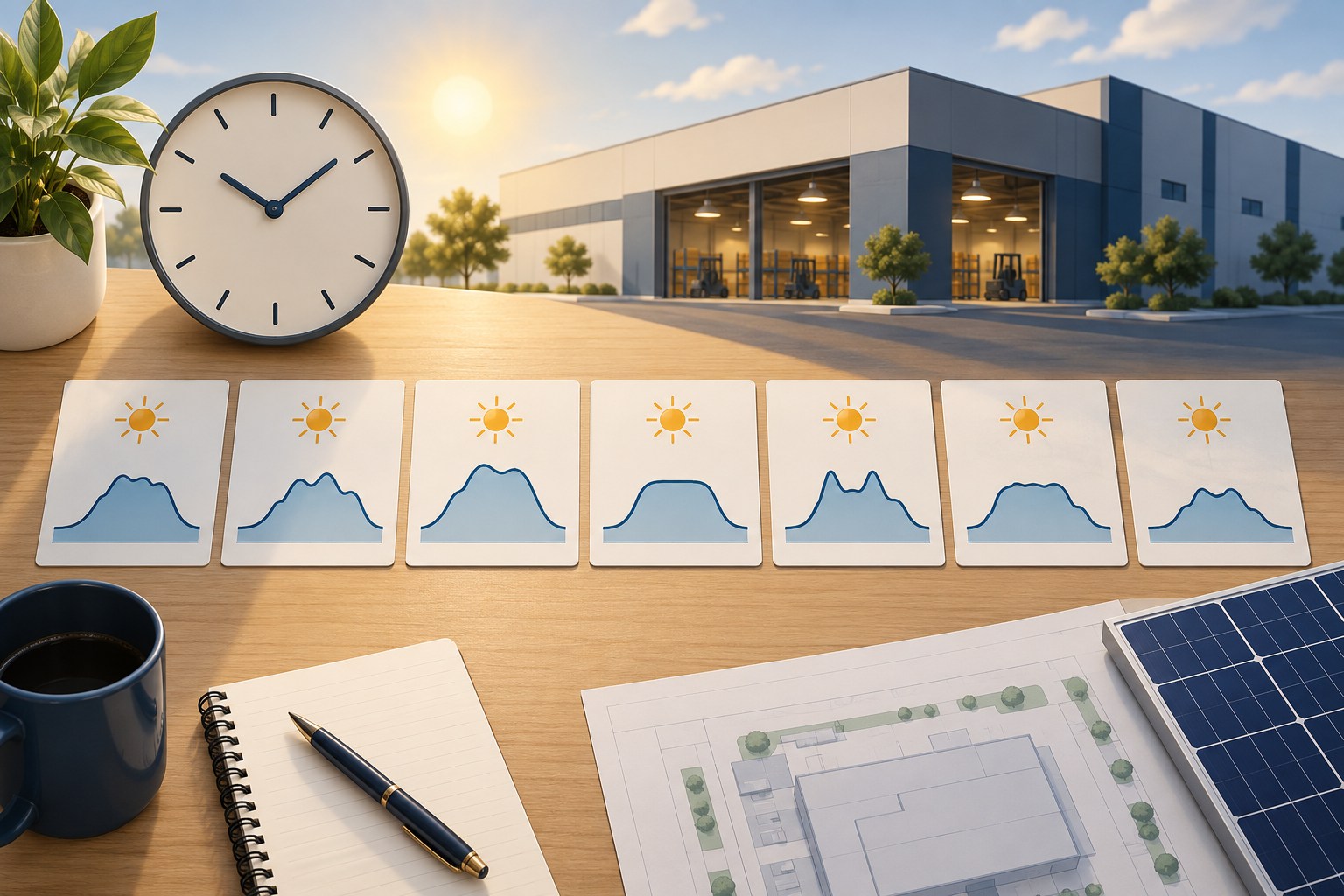

Start with when the power is actually used
Before asking how many panels will fit on the roof, ask what the building runs on while the sun is up. A factory working day shifts and a warehouse that lights up at night can have very similar monthly bills, yet each needs a different set of data behind the design. Preparing that data clearly makes both the site survey and the proposal discussion far more productive.
PEA advises sizing a rooftop solar system to match how electricity is actually used; the source article illustrates this with households. For a business, do not take a residential system size and apply it directly. The checklist below is a way to organise information for a conversation with a designer — it is not a system-sizing calculation or a savings estimate for any particular building.
Collect bills across a full year
Start with roughly 6–12 months of past bills if you have them. Keep the units consumed, the amount charged, the meter reading dates, and the tariff type shown on the bill. If the premises have several meters, file them separately by building or activity; do not merge totals to the point where you can no longer see which load sits on which connection point.
Note beside each bill any month with a major shutdown, an added shift, an office move, or special work. The amount charged can move because of both consumption and the components of the tariff, so a single month in baht should not stand in for the whole pattern of energy use. Where documents are missing, state the gap rather than filling it with a guessed figure presented as fact.
Separate energy from power
kWh tells you the energy accumulated over a period; kW tells you the power drawn at a moment. They answer different questions. Monthly totals show quantity but not when loads coincide. Dividing a month's units by the number of hours gives an average only — it is not a real load profile.
List the main equipment — air conditioning, machinery, pumps, refrigeration — with approximate start and stop times, and note whether each runs continuously or intermittently. Nameplate data is a starting point, but do not assume every machine draws its rated power all the time. If measurements inside a switchboard are needed, leave that to a qualified person; do not open panels or touch circuits yourself to collect data.
Record working days, holidays and base load
Build a one-week table with columns for the day, opening hours, production hours, break periods, and equipment still running after closing. List weekly days off and long shutdowns separately. If you have interval meter data, keep the original file together with its units and date range so the designer can read the differences between days.
A hypothetical example: building A and building B use the same total energy per month, but A runs daytime work six days a week while B is mainly used in the evening. The same total is therefore not enough to conclude that both should have the same system. This example shows how to frame the question; it is not an assessment of value or of electricity output at any real site.
Prepare roof information and business changes
Gather whatever building drawings exist, roof photographs taken from a safe position, any history of leaks or repairs, and the position of obstructions you already know about, such as neighbouring buildings or trees. A real survey still has to check the structure, equipment space, cable routes and shading. Do not rely on photographs alone to certify that the roof can carry the load.
Flag firm plans — adding machinery or changing shifts within a few months — and keep unapproved plans separate from current operations. Giving two sets of assumptions lets a bidder explain how the analysis changes if the business expands, rather than over-sizing on the basis of expectations that nothing yet supports.
Use the same questions on every proposal
Ask each proposal to state which period the calculation is based on, how working days and holidays were treated, whether generated energy and self-consumed energy were estimated separately, and what assumptions were made about shading, degradation and system downtime. Ask as well about the connection conditions and how surplus power is handled on the actual project.
A ready-to-send data pack should contain bills separated by meter, an operating schedule, a list of the main equipment, roof information, and the questions you want answered. Kintury Energy lists solar survey, design, installation and maintenance services on its website, so this pack works as a starting point for arranging a survey — with the site-specific assessment being the thing you actually decide on.