
Start with the installed system
If a building already has solar and wants to store energy for evening use, the first question is where storage connects and whether existing equipment supports it, before choosing a kWh capacity. AC and DC coupling describe integration approaches, not quality grades that make one universally better.
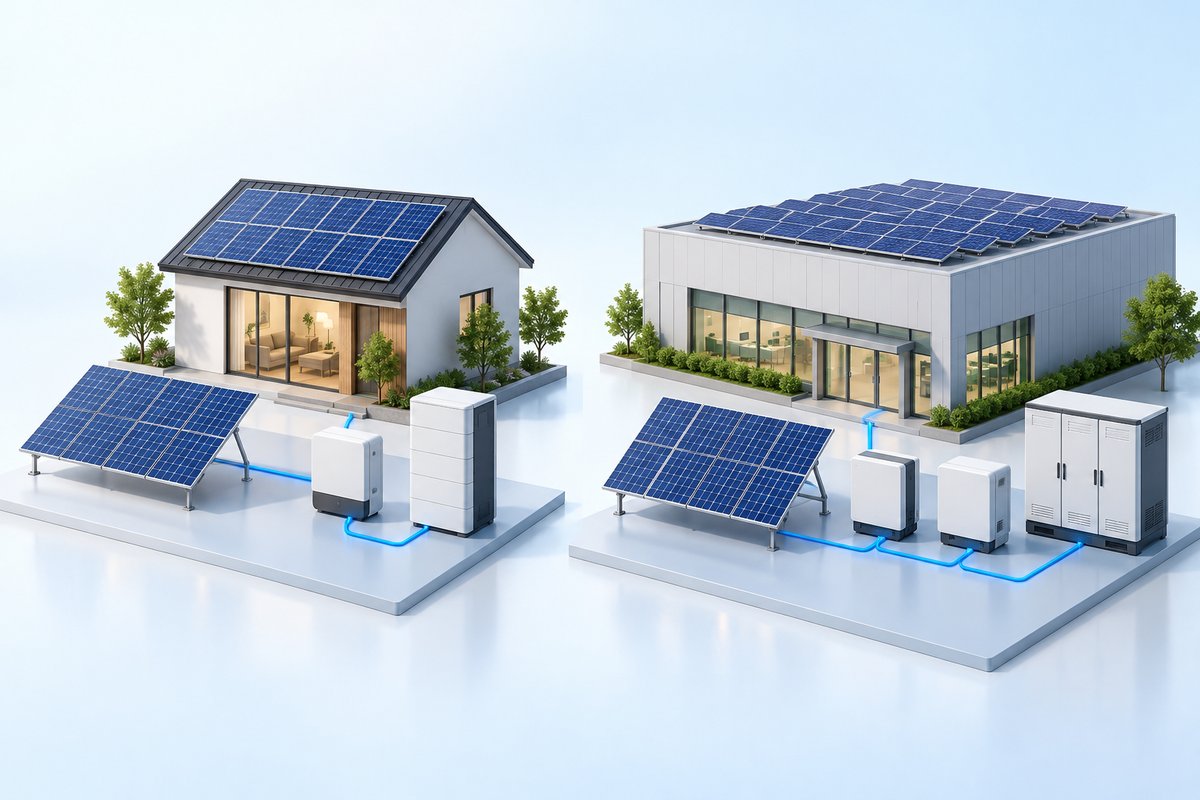
Australian government guidance from YourHome explains that panels and batteries use DC while ordinary appliances use AC, requiring conversion along the path. A diagram separating panels, inverters, storage and load circuits reveals what an offer retains or replaces. These are technical principles, not Australian installation rules presented as Thai requirements.
Ask the supplier to show both paths
With AC coupling, solar output passes through the solar inverter into AC, then through battery-side conversion into DC for storage. Supplying AC loads requires another conversion. This may retain the existing solar inverter, but the actual equipment combination still needs review; it does not mean any battery can simply be connected.
With DC coupling, panels and storage connect on the DC side through suitable control equipment before conversion for AC use, potentially removing some conversion stages when storing solar energy. Check inverter model, battery voltage, controls and the manufacturer’s supported equipment list. The word hybrid on a quotation is not compatibility evidence for every model.
Compare the complete retrofit scope
For a hypothetical building with a recently installed, functioning solar inverter, an AC-coupled offer might retain it while a DC-coupled offer replaces it. Comparing battery prices alone misses added equipment, switchboard work, configuration, testing and effects on existing warranties. Ask suppliers to separate confirmed scope from items awaiting investigation.
A building already replacing its inverter may reach a different conclusion. Compare offers against the same loads and objectives, with consistent efficiency measurement boundaries. Fewer conversion stages are one consideration, not a complete investment result or a statement of backup duration.
Check outage operation separately
Neither coupling label guarantees backup. Ask the designer to identify circuits available during an outage, grid-isolation equipment and whether that exact system can recharge from solar during the outage, including power limits and transfer behavior. Responsible personnel should define and perform the tests; do not experiment with wiring yourself.
Before discussing the project with Kintury Energy, prepare the existing inverter’s model and age, system diagram, usage history and evening-use or outage goals. Request a comparison of retained, replaced and still-unverified elements. If model information is missing, confirm it before selecting storage rather than purchasing first and trying to make it fit.