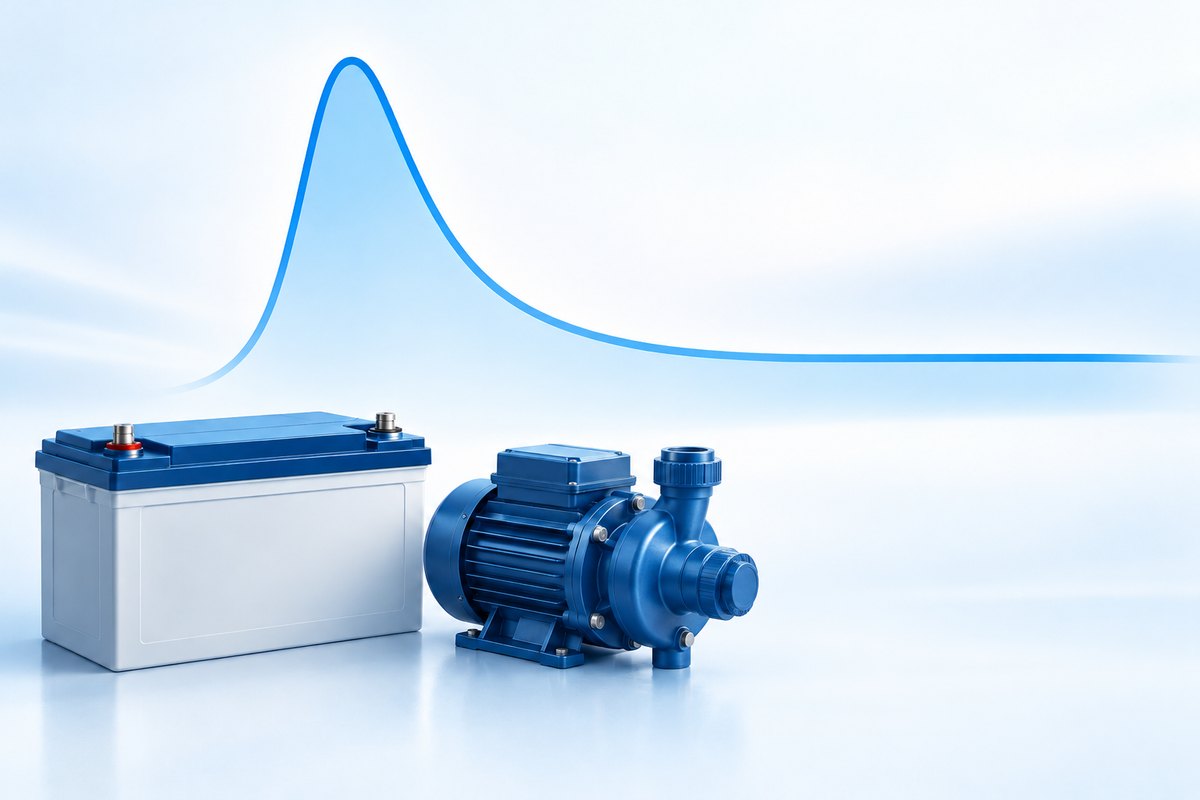

Remaining energy is not a starting guarantee
During an outage, lights and a router may work while a pump starts and stops, even though the battery app shows charge remaining. Adding kWh is not automatically the answer. Separate how long stored energy can support use from whether the system can supply the demand at startup. Capacity alone does not describe the combined limits of the battery, inverter and backup circuit.
This article uses a motor-driven pump to frame design questions. It does not diagnose a defective pump or imply every solar installation supports backup operation. Medical, fire-protection or other safety-critical equipment requires its responsible specialist to define the applicable requirements before a backup solution is selected.
Read both continuous and short-duration ratings
kWh measures energy and kW measures power at a given time. Even if normal running loads appear below the rating, startup still needs checking. Victron’s Inverter Smart manual explains that motors or pumps can draw starting current above the inverter’s protection threshold. That describes the mechanism for that product; it is not a universal multiplier for every motor.
A peak rating must be read with its supported duration, temperature and model-specific conditions. A brief high output does not guarantee it can last until the machine starts. Nor should VA be read directly as W without considering the load. Ask the system provider to show the data used to match equipment and demand, rather than choosing the largest advertised peak.
Example: startup order changes the test
Hypothetical example: an office keeps lighting and networking on while a pump starts in response to water pressure. At another moment, a refrigerator starts at the same time as the pump. These have different starting conditions even if daily energy use is similar. Separate continuously running equipment from cycling loads, and identify which simultaneous starts can actually be controlled.
Staggered starts may be an option for the designer, but not a universal fix. If one pump alone exceeds the system capability, or equipment must start together automatically, another design must be assessed. Building users should not have to rely on remembering manual switching sequences to compensate for an unsuitable design.
Collect evidence without repeated forced starts
Provide pump, inverter and battery models and labels, plus other loads on the backup circuit. Photograph only safely accessible labels. Preserve the exact alert, time, state of charge and equipment running. If the app reports low voltage rather than overload, record that fact instead of relabelling it to fit an assumption.
Do not bypass protection, fit a larger breaker or change battery cut-off settings yourself. Repeated attempts to prove the pump sometimes starts are not a sound test. Starting-current measurement, wiring checks and supply-transfer testing belong to qualified personnel following safe procedures; an app screen alone cannot distinguish every cause.
Accept a proposal against realistic test conditions
Ask proposals to specify supported loads, equipment combination, initial conditions, test scenarios and exclusions. If equipment is added or control methods change, ask which limitation is addressed and which remains. A light-bulb demonstration does not answer the pump question, and one successful start does not establish performance in every operating condition.
Before discussing a project with Kintury Energy, prepare the load list and evidence above, together with the work that must continue during an outage. This helps define the solar and backup scope. System size and capability still require verification against actual equipment, design and site conditions; the examples here do not replace engineering calculations.